Compare Swamp Coolers, Central AC and Heat Pumps
These labels describe different cooling mechanisms and delivery systems. A good comparison starts by separating them.
On this page
A “swamp cooler,” “central AC,” “heat pump” and “mini-split” are not four neatly separate categories. A swamp cooler uses evaporation. Central AC uses a refrigeration cycle. A heat pump uses refrigeration to cool and can reverse the process to heat. A mini-split describes a split-system configuration that may be ductless or use short ducts; many are heat pumps.
Not sure which system your home has?
Cooling equipment is not always easy to identify from the thermostat or a vent. These familiar features can help you recognize what may be installed—without having to diagnose it yourself.
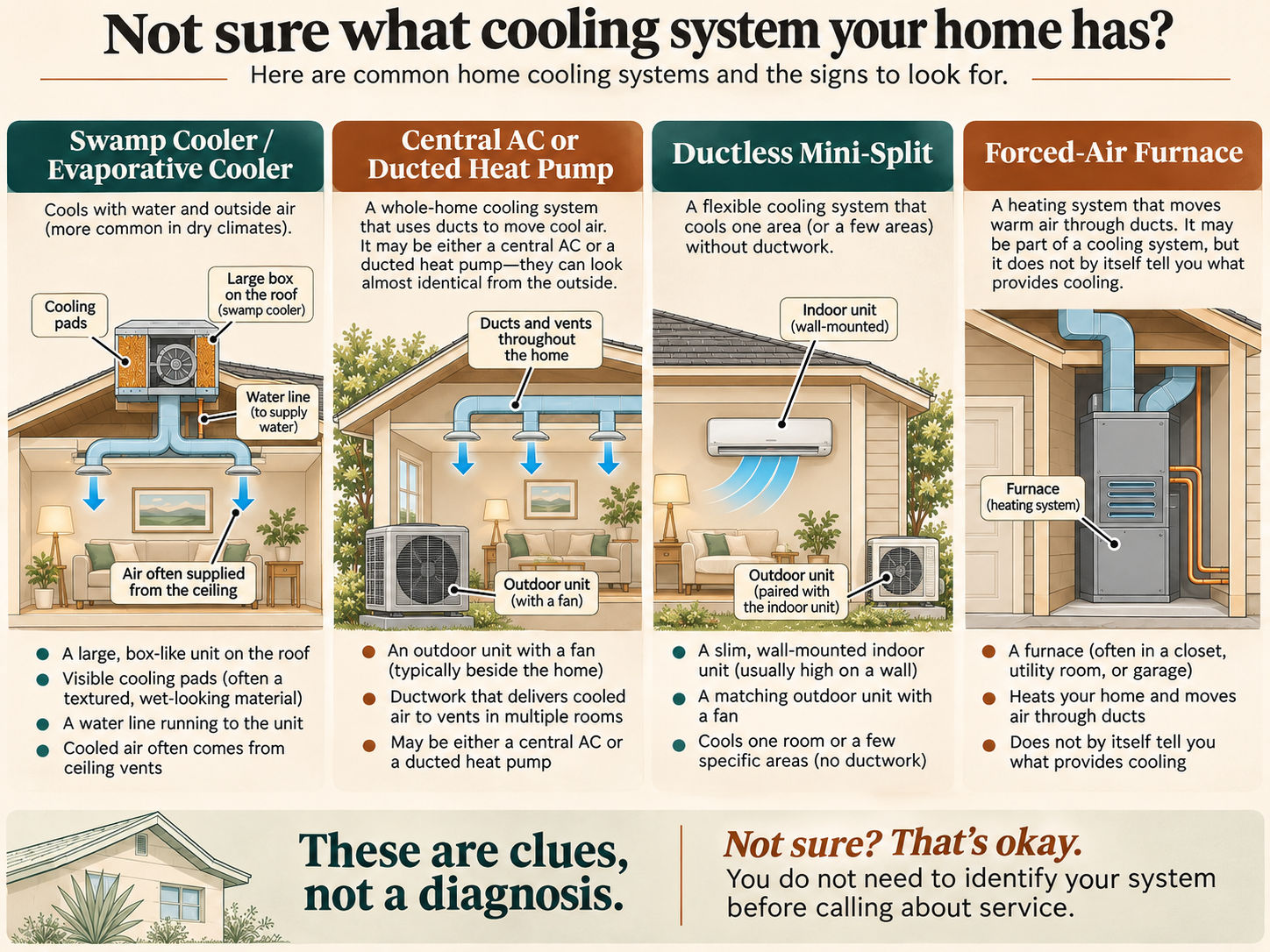
You do not need to identify your equipment before calling about service. Simply describe the cooling issue or change you're considering; the receiving provider handles the technical questions.
A practical comparison
| Question | Direct evaporative cooler | Ducted central AC | Ducted heat pump | Ductless mini-split heat pump |
|---|---|---|---|---|
| How it cools | Outdoor air through wetted media | Refrigeration; commonly recirculated indoor air | Refrigeration; commonly recirculated indoor air | Refrigeration; indoor room/zone units |
| Outside humidity | More sensitive to humidity | Cooling not based on evaporating water into indoor air | Same general cooling principle as AC | Same general refrigeration principle |
| Distribution | Requires outdoor-air supply and relief path | Supply ducts and appropriate returns | Supply ducts and appropriate returns | Separate indoor units / zones |
| Heating | Not its purpose | Not provided by a cooling-only AC unit | Yes, with design limits by climate and equipment | Often yes, with model- and layout-dependent coverage |
| Existing house questions | Water, pads, roof and air relief | Ducts, returns, indoor coil/handler and power | Ducts, returns, heating integration and power | Room coverage, mounting, condensate and power |
The table describes broad principles, not the capabilities of every product. There are variations, including packaged units and hybrid systems.
Why evaporative cooling can be attractive—and limiting
Evaporative cooling can be particularly effective in dry weather and is a legitimate choice for many homes. But it uses water, depends on proper air movement and brings outdoor air into the house. High outdoor humidity reduces the evaporation-driven temperature difference available. A homeowner whose main frustration is weather-dependent comfort may be facing a system limitation rather than a specific failed component.
What refrigerated AC changes
Refrigerated cooling removes heat through a vapor-compression system rather than depending on water evaporation in the living space. A conventional ducted installation generally keeps windows closed and recirculates air through supply and return paths. Converting an older evaporative home may therefore require more than an outdoor condenser—especially if the house lacks compatible ductwork or return paths.
Why the word “heat pump” matters
A heat pump can provide heating and cooling, potentially changing the role of an existing furnace or other heat source. Some systems are designed for cold climates, but performance and backup-heating decisions depend on the actual Utah County home's load and the specified equipment. “Heat pump” does not tell you by itself whether a system is ducted or ductless.
Why “ductless” is not shorthand for “cheap”
Avoiding a major duct retrofit can be attractive, but a single indoor head does not magically condition every closed room. A whole-home ductless design can require multiple indoor units, refrigerant and condensate routing, electrical work and suitable service locations. The right comparison is the completed scope and rooms served, not the sticker price of one device.
Match the system to the problem
If the cooler needs a repair and otherwise meets comfort needs, the first conversation may be straightforward service. If the household wants more predictable cooling across rooms, the evaluation is broader: envelope, distribution, heating, electrical supply and installation disruption. A contractor should assess those constraints and recommend a design, not ask the homeowner to guess the tonnage.
The most useful next reading is repair or convert, followed by the conversion scope guide or ducted versus ductless comparison. Call 502-395-6063 for a service inquiry; qualifying routed calls may compensate this independent publisher.
Sources and further reading
- DOE — Home Cooling
- ENERGY STAR — Clean Heating and Cooling
- ENERGY STAR — Ductless Heating and Cooling
- DOE Building Science — HVAC Ducted Returns
- ENERGY STAR — HVAC Quality Installation
Independent homeowner information. We do not perform HVAC work. Call 502-395-6063 for a service inquiry. Routing depends on availability, and qualifying calls may compensate this publication. Referral disclosures.